
Service design
End to end redesign of salary assessments for teachers
May 2018 to June 2018
Key info
Project type
Service design
Team size
1
My role
Led the research and design of service
Tools used
Visio
Skills used:
-
Planning user research
-
Conducting stakeholder and customer interviews
-
Qualitative data analysis
-
Current state process mapping
-
Facilitating workshops
-
Service blue printing
Background
The Salary Assessment Unit required a redesign of their services. They are part of a large payroll organisation that pays around 50,000 teachers.
The unit assesses teachers' qualifications and relevant experience in line with their relevant collective agreement, in order to place them in the correct qualification group and step and ensure they receive the correct salary.
The unit processes approximately 8,000 requests a year. In order to assess a teacher's salary, they required a 4 page PDF form to be completed, signed and posted along side with certified true copies of the teacher's qualifications via post. Requests to complete, correct or provide more information were posted to the applicant
Below are two pages one type of salary assessment form


Problem
Users need to fill in a 4 page form that has vague instructions and then post it to the service centre. If there are any errors, the service centre will post the application back explaining the errors. This is inefficient and frustrating to our customers. I was tasked to review the salary assessment service for a large payroll system and recommend enhancements to improve the customer experience within 4 weeks.
Process
Research
Desk research to understand the current process of the salary assessment service and quickly mapped out the service. Planned and conducted interviews with SMEs, the salary assessment manager and their staff to understand the service, their pain points (e.g. not able to speak directly with customers; concerns around fraud prevention) and any limitations for future improvements.
Interviewed schools to understand their side of the service and what their pain points
Analysis
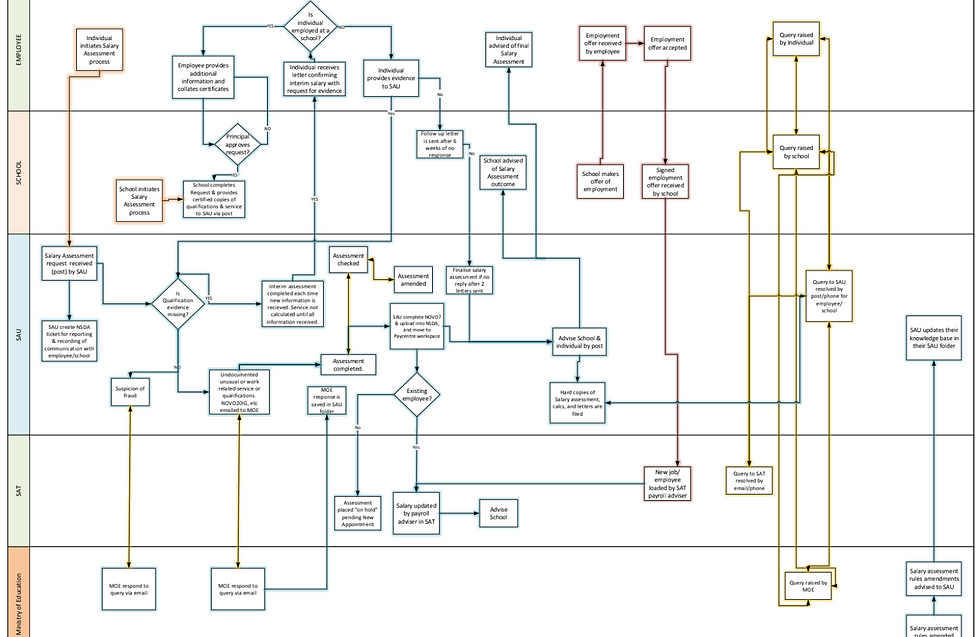
Mapped the current state of salary assessments from the perspective of the paycentre, schools and other key stakeholders.
Identified pain points for schools, the service centre and other key stakeholders. Key pain points included:
-
slow service
-
antiquated communication (e.g. applications sent in by post as signatures were required to try and prevent fraud); customers were notified of errors in applications by post;
-
no calls made to customers regarding their application;
-
confusing application form)
Salary assessment current state
Concepting
-
Reviewed processes of similar organisations to gather ideas to improve salary assessments
-
Organised and facilitated future state ideation sessions with key people to resolve key pain points.
-
Using the solutions from the facilitation session and research of other organisations, I mapped out the ideal process to reduce pain points.
-
Also made recommendations to improve the salary assessment forms based off pain points and best practice form design
Recommended changes to salary assessments
Submission and application
-
Original documents are sighted, photocopied, photocopied documents are certified and scanned and attached to email to the service centre.
-
If employee is emailing the application, they must cc the principal. Principal is notified by email that someone has confirmed that the principal have viewed and approved the application on the principal’s behalf. The principal is responsible for contacting service centre if they believe that the application is suspicious.
-
Automatic acknowledgement email is sent to the employee and school to advise the ticket number, that we received the application, and estimated turn-around time.
Communication
-
Phone calls are made to school/employee to request more information. Followed with an email to request amended or more information.
-
Employees/schools can email the amended documentation to service centre
-
Outcome letter emailed to the principal and employee. This is to ensure that the principal is aware that SAU have salary assessed the employee and that service centre has placed the employee on a particular pay rate. The principal should be aware if the information is correct and can take action if it is suspicious.
-
Employee can call the service centre with specific queries.
-
Service centre to have an identification protocol to ensure they are speaking with the actual employee who applied for the salary assessment.
-
Paycentre can talk face-to-face to SAU when they have queries at about a salary assessment
Salary assessment forms
-
Provide definitions for terms like “professional and technological” qualifications
-
Add space for hours and employment status (e.g. part time) in the service fields
-
Include the employee’s email address.
-
Remove gender. This is not needed to assess salary nor is it useful for identifying a person
-
Allows certifiers of documents to use alternative wording to certify a document. For example, “I confirm that is a copy of the original document”. Examples of appropriate wording is provided.Included clearer instructions on completing the forms
Impact
-
Most future state recommendations were implemented, leading to improved customer satisfaction.
-
Estimated that switching to email communications saved approx. $10,000 on postage per year and 192,000 hours of processing time per year.
-
In 2020/2021, 100% of salary assessments were processed within the 15 day timeframe.
-
In 2020/2021, 100% of salary assessments were processed accurately.
What I'd do differently
Tested ideation concepts with actual internal users and customers. We made assumptions on what might work but didn't validate these assumptions.